Overview:
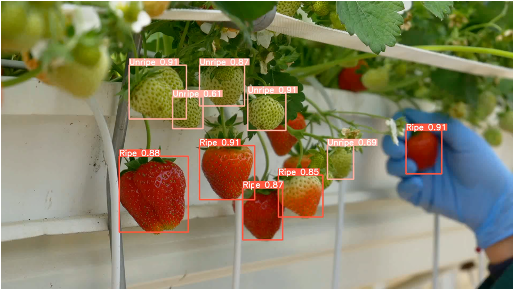
This project focuses on applying object detection to automate fruit-picking, specifically detecting and classifying strawberries as ripe, unripe, or diseased. Various models, including YOLOv5, Faster R-CNN, and EfficientDet, were assessed. YOLOv5 was determined to be the most suitable for real-time detection, balancing accuracy and speed.
Screenshots:


Key Features:
1. Model Comparison:
The evaluation included YOLOv5, YOLOv7, YOLOv8, Faster R-CNN, and EfficientDet. YOLOv5 was selected for its superior balance of accuracy (mAP 94.1%) and speed, crucial for real-time applications.
2. Custom Dataset:
The dataset consisted of 240 images, with strawberries annotated for classification into ripe, unripe, and diseased categories. Data augmentation techniques like flip, rotation, and blur were applied to improve model performance.
3. Two-Stage vs. One-Stage Detectors:
Faster R-CNN, a two-stage detector, was compared against one-stage detectors (YOLO, EfficientDet). While Faster R-CNN provided higher accuracy, YOLO models proved faster, making them more suitable for practical field applications.
4. Augmentation and Preprocessing:
Various data augmentation techniques were used to enhance the training dataset, such as flipping, rotation, and blurring images, ensuring a diverse training set that improved the model’s robustness.
5. High Accuracy with Ripe/Unripe Detection:
YOLOv5 achieved 94.1% accuracy for distinguishing ripe and unripe strawberries. This accuracy extended to real-time video detection, making it a promising candidate for automated fruit-picking systems.
6. Challenge of Disease Detection:
The model showed some difficulty in detecting diseased strawberries, especially when distinguishing between similar-looking diseases (Anthracnose and Gray Mold). Increasing the dataset and refining classifications were suggested for improving disease detection.
7. Data Mining and Classification:
The Orange tool was used to classify disease types, achieving 74-80% accuracy, indicating the model’s potential for handling more complex classifications with further training.
8. Future Improvements:
Adding more data, especially for diseased strawberries, and improving augmentation techniques to enhance the model’s accuracy, particularly in challenging areas like background interference and disease detection.
Category:
Tags:
Links:
 Portfolio
Leave a comment